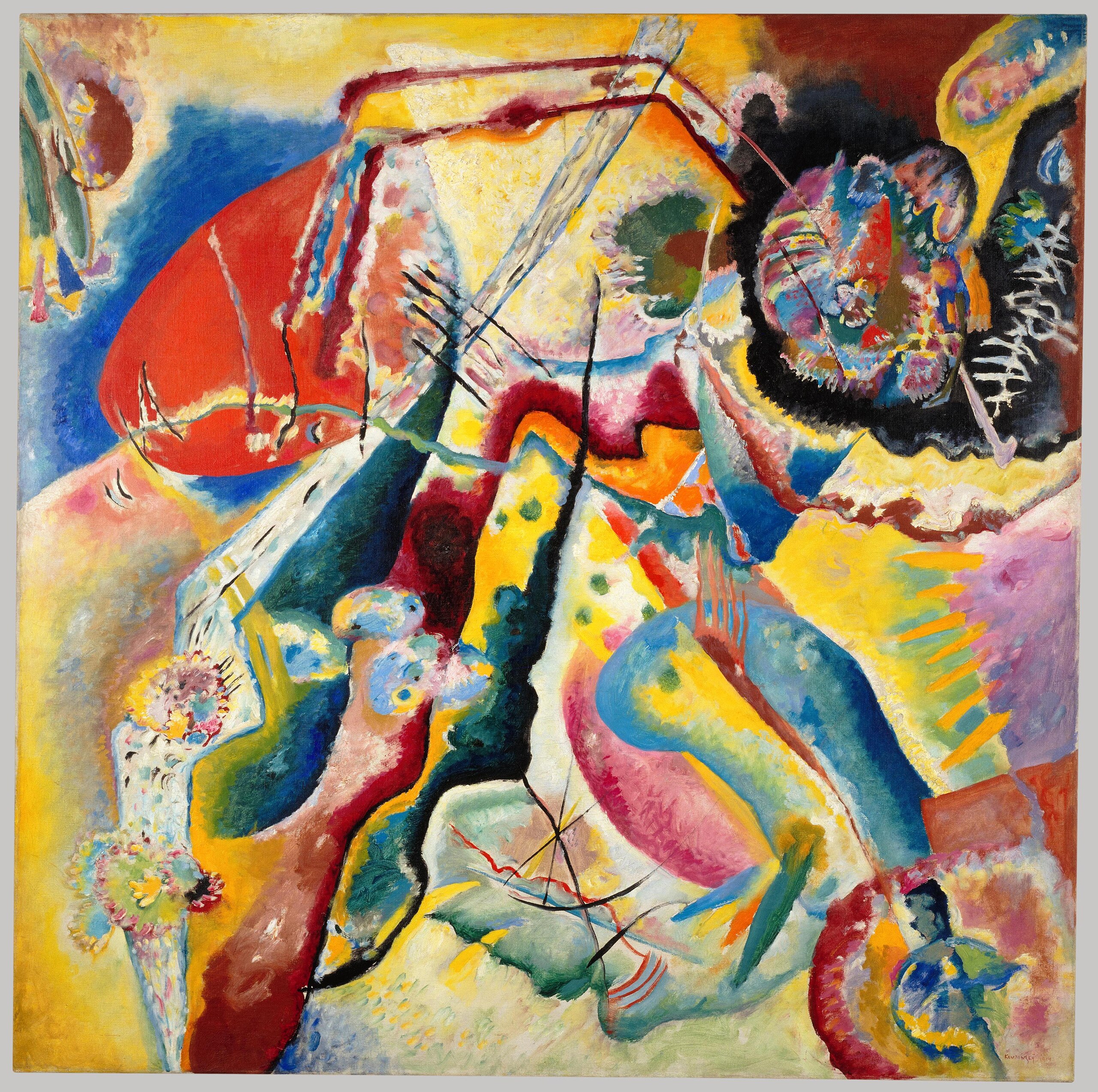
When Wassily Kandinsky attended Wagner’s Lohengrin at Moscow’s Bolshoi Theatre, something shifted in his perception. Music produced colour and line in his vision. Sound became image. Kandinsky experienced synaesthesia—a cross-sensory phenomenon that would reshape twentieth-century art. For him, middle C wasn’t just a sound; it was a colour. That sensory crossover would dismantle centuries of artistic convention and transform a thirty-year-old law professor into the man widely credited with inventing pure abstraction.
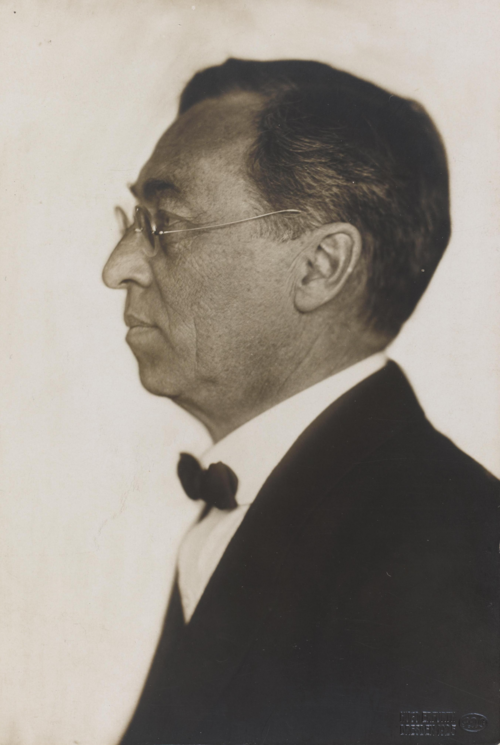
From Law Lectures to the Munich Academy
Born into Moscow’s merchant class in 1866, Kandinsky followed a respectable path. He studied law and economics, securing a lectureship at Dorpat University. Then came two encounters that changed everything: Monet’s Haystacks and Wagner’s Lohengrin. In 1896, he resigned his post and moved to Munich to study painting. The decision mystified his colleagues.
Despite their scepticism, his early training was rigorous. At the Munich Academy, Franz von Stuck restricted him to black and white for an entire year, curbing what he considered Kandinsky’s excessive colour instincts. The constraint proved formative, forcing Kandinsky to master form and composition before reintroducing colour with deliberation and force.
Murnau: Where Landscapes Reached Auction Records
Between 1908 and 1911, Kandinsky painted obsessively in the Bavarian village of Murnau, producing works that now sit at the apex of his market. The landscapes remain recognisable, but only just—colour intensifies, form loosens, and meaning begins to detach from representation.

During this period, works like Der Blaue Reiter (1903) began to emerge—a cloaked figure charging through a fractured landscape, painted with thick, energetic brushstrokes. This painting would later lend its name and symbolism to the artist collective Kandinsky co-founded with Franz Marc in 1911. Marc loved horses, Kandinsky favoured blue, and the group’s identity followed naturally from these shared affinities.

This collaboration marked a clear shift in Kandinsky’s approach. Paintings such as Blue Mountain show Fauvist colour dominating the canvas—a vivid blue peak flanked by yellow and red foliage, while riders surge across the foreground. Biblical references, particularly the Four Horsemen of the Apocalypse, recur throughout this period, foreshadowing Kandinsky’s growing interest in spiritual themes that would define his theoretical writings.
Painting Like a Composer
Kandinsky’s breakthrough came with a series of monumental works he called Compositions—not spontaneous gestures but meticulously planned canvases executed with the rigour of a symphonic composer. Dozens of preparatory studies preceded each final work, establishing a creative process that mirrored musical composition.
Composition VII (1913), widely regarded as his masterpiece, measures two by three metres. It compresses themes of flood, judgement and resurrection into a vortex of colour and line. Kandinsky worked on preparatory sketches for months before executing the final painting in just three days.

Examined closely, fragments emerge—Cossacks with lances, boats, reclining figures, a hilltop castle—but clarity resists. Kandinsky had developed his own visual language, reducing recognisable forms to symbolic elements that functioned like musical notation rather than literal depiction. This vocabulary would become the foundation for all abstract art that followed.
Bauhaus Precision
The First World War dissolved Der Blaue Reiter and sent Kandinsky back to Russia. The Revolution proved inhospitable to his spiritual outlook, and by 1922, he had returned to Germany to join the Bauhaus.
His work changed fundamentally in this new environment. Intuition gave way to geometry, replacing the swirling forms of his earlier period with circles, triangles and lines arranged with mathematical clarity. Composition VIII (1923), now in the Guggenheim Museum, demonstrates this shift: colour becomes calibrated, shape carries psychological weight, and abstraction acquires structural discipline.
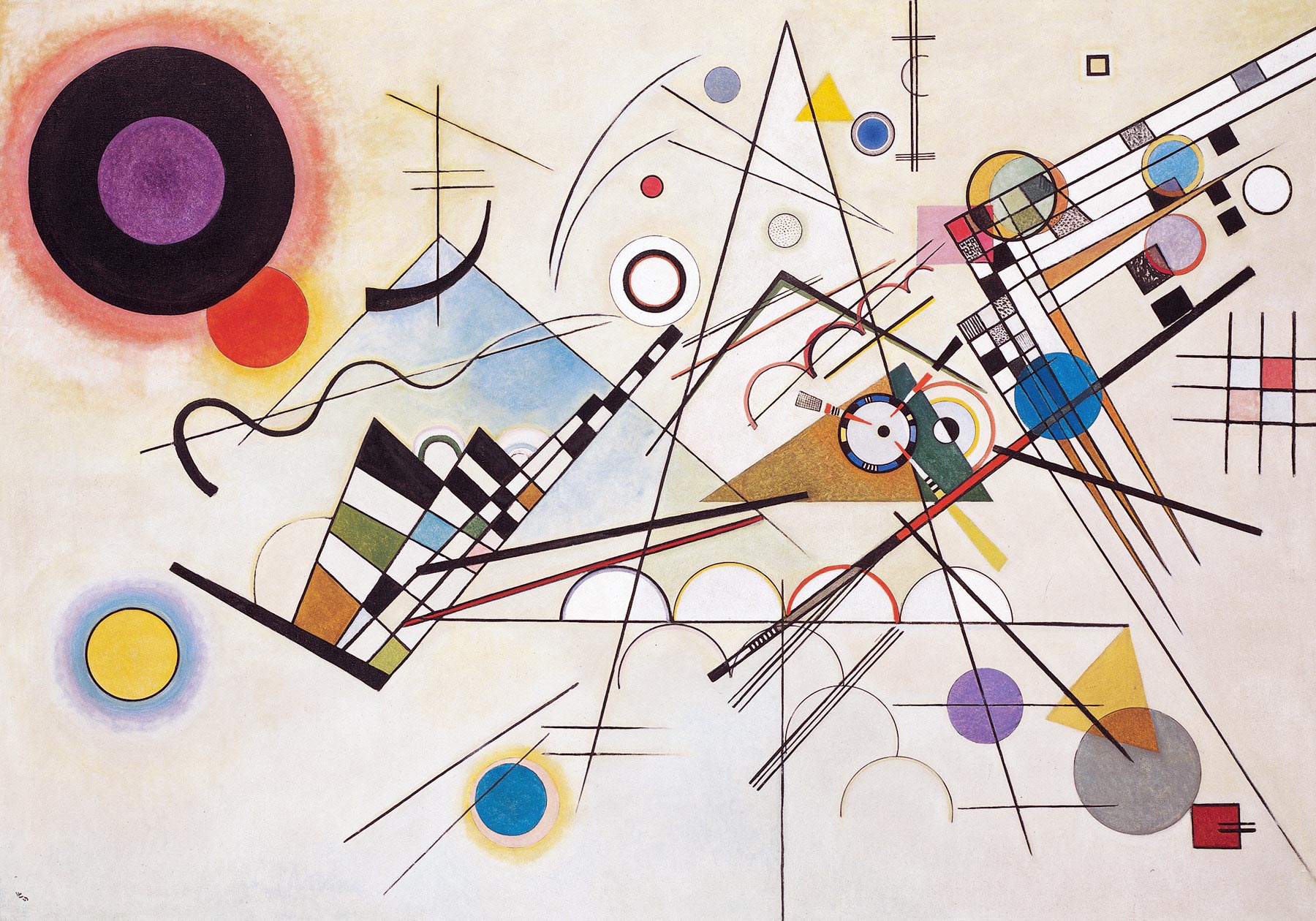
This analytical approach reached its apex with Yellow-Red-Blue (1925), which distils Kandinsky’s colour theory into a single canvas. Yellow radiates warmth, blue recedes into depth, and red aspires upward. The painting is less expressive than analytical—yet no less emotionally charged.

Paris and the Final Works
When the Nazis closed the Bauhaus in 1933, branding Kandinsky’s work “degenerate art,” he relocated to Paris. His late paintings soften considerably from the Bauhaus rigidity, with biomorphic forms appearing to suggest organisms, cells, and microscopic life—yet still coexisting with geometric discipline.
Several Circles (1926) exemplifies this mature period, where geometric rigour meets meditative stillness. Concentric circles of varying scale and colour hover in subtle spatial tension, creating a sense of infinite depth. The painting demonstrates Kandinsky’s continued exploration of synaesthesia, where colour, form, and composition function like musical notes, each carefully calibrated to evoke emotion.

His final major work, Composition X (1939), represents the culmination of decades of abstract experimentation. The canvas unites biomorphic forms with geometric precision, balancing organic and constructed elements in harmonious dialogue. Darker tones, punctuated by bursts of bright colour, create dramatic tension—evoking both the turbulence of the era and Kandinsky’s personal evolution as war loomed across Europe.

These late works remain comparatively undervalued at auction, though institutional interest is increasing. His theoretical framework, however, informed generations of artists who followed. Abstract Expressionism, Colour Field painting, and elements of Minimalism trace lineage directly to Kandinsky’s assertion that colour and form could function independently of representation. That intellectual architecture—not merely the paintings themselves—explains why major institutions guard their holdings so carefully and rarely release significant works to the market.
The Market Reality
Kandinsky’s auction record currently stands at £37.2 million ($46.5 million) at hammer. The result came in March 2023 when Murnau mit Kirche II (1910) sold at Sotheby’s London following restitution to the Stern family. Including buyer’s premium, the total price exceeded £41 million ($51 million). The record stands as of December 2025. Such distinctions matter: at this level, premiums typically exceed 15%, significantly affecting acquisition budgets for serious collectors.
The sale underscored several market truths that persist today. Murnau works command exceptional premiums due to their transitional significance between representation and pure abstraction. Provenance is paramount, particularly for works affected by Nazi-era displacement and subsequent restitution claims. Most critically, supply is extremely limited, with major paintings largely held by museums that rarely deaccession.
These supply constraints are structural rather than cyclical. Major Compositions reside almost exclusively in institutional collections: the Guggenheim holds over 150 works, alongside substantial holdings at MoMA, Centre Pompidou, and Munich’s Lenbachhaus. Works from the critical 1910–1914 period in excellent condition with unbroken provenance are now virtually unobtainable outside exceptional circumstances such as restitution cases or estate sales.
Recent results confirm this scarcity premium. In November 2024, Weisses Oval (1921) achieved £28.5 million ($35.6 million) at Sotheby’s London, demonstrating sustained demand for his geometric abstract compositions from the Bauhaus period. The same evening saw Murnau – Landschaft Mit Grünem Haus (1909) sell for £24.8 million ($31 million). Before the 2023 record, Painting with White Lines (1913) had held the top position at £33 million ($41.2 million) in 2017.


For buyers navigating this market, the hierarchy is clear. Early Expressionist landscapes from Murnau and Bauhaus abstractions dominate pricing, while major Compositions numbered I through X are effectively unobtainable. This leaves late Paris works to offer relative value, though they require greater connoisseurship to appreciate fully.
Within this landscape, UK collectors face familiar but significant challenges. Authentication requires expert verification beyond the Roethel-Benjamin catalogue raisonné and subsequent updates. Kandinsky’s prolific output and the dispersal of works during Nazi-era confiscations mean provenance gaps persist, requiring specialist examination of paint analysis, canvas dating, and exhibition history. Beyond authenticity concerns, storage and insurance costs are substantial. Insurance typically runs 0.15–0.25% of value annually, and conservation requires climate-controlled environments with UV protection to prevent pigment degradation—considerations that can add tens of thousands of pounds annually to ownership costs.
The Theoretical Foundation
Kandinsky didn’t simply create abstract art—he provided its intellectual architecture. His 1911 treatise Concerning the Spiritual in Art argued that colour could convey emotion independently of subject or form. The idea was radical then. It is fundamental now to our understanding of how visual art functions.
His influence runs from Pollock to Rothko, from Newman to Riley. His paintings demonstrate that visual art can function like music—emotional, non-representational, and affecting without narrative. For collectors, a Kandinsky represents more than an acquisition or investment. It is ownership of the moment art broke free from depiction and discovered a language that would define modernism—one that continues to shape how institutions curate, how markets value, and how we understand the purpose of painting itself.
Artworks by Wassily Kandinsky (left-hand side, top to bottom): On White II (1923); Circles in a Circle (1923); Bild mit rotem Fleck (1914); Composition VI (1913); Points (1920)