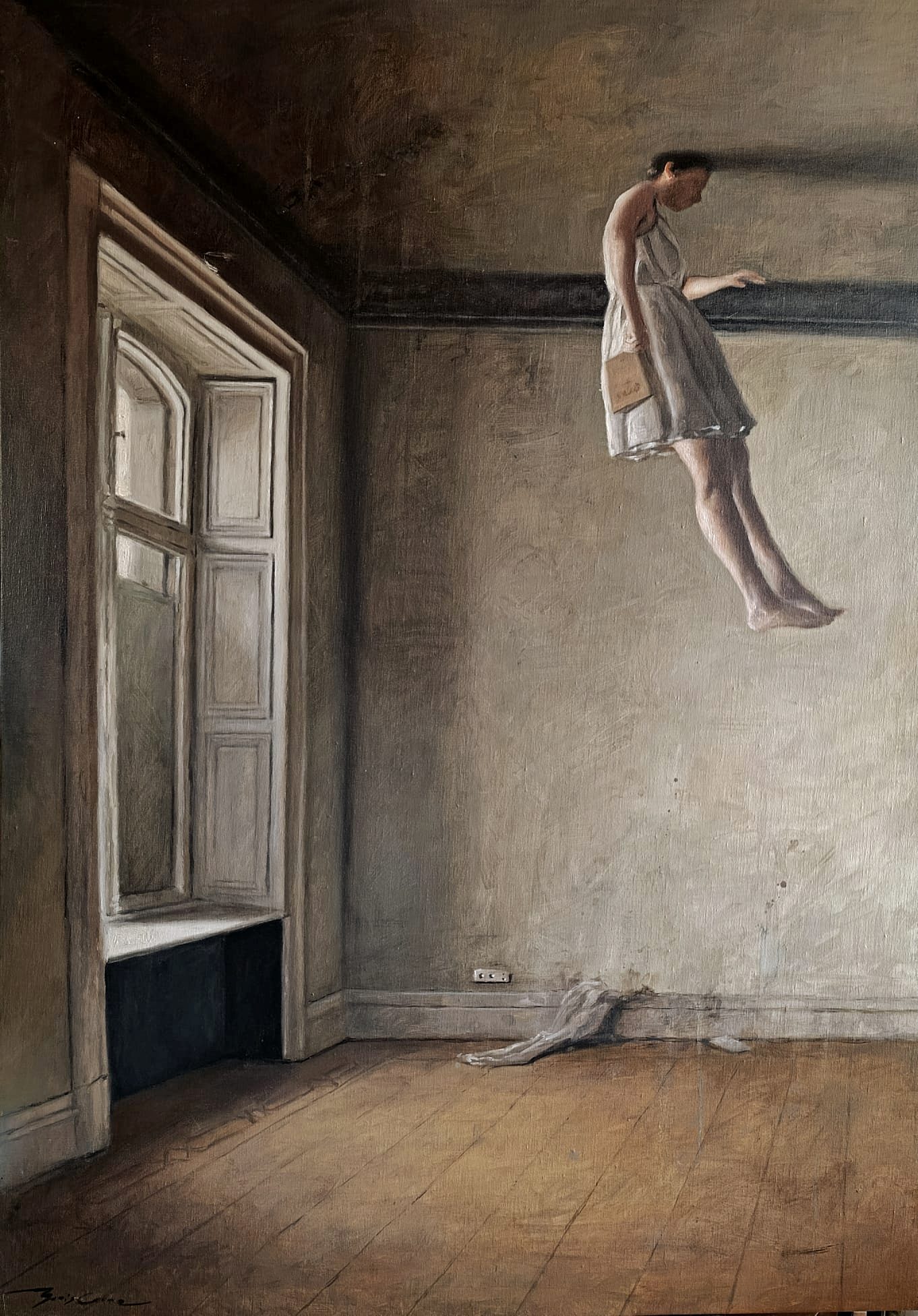
Boris Correa’s paintings are built around the slow emergence of light from deep shadow, drawing on the old masters’ use of chiaroscuro. His figures appear solid yet psychologically distant, while his scenes feel remembered rather than witnessed. Narrative clarity is secondary to atmosphere, tension, and the elusive space between the tangible and the imagined. Behind this discipline is an artist whose visual instincts were shaped as much by cinema as by painting.
Born in Santiago, Chile, Correa developed an early fascination with the expressive possibilities of images beyond painting. Cinema became an important influence on his visual imagination, shaping his sensitivity to atmosphere, narrative ambiguity and the construction of imagined worlds.

He went on to study at the Academia de Bellas Artes Martín Soria, an atelier grounded in the classical methods of the School of San Fernando in Madrid. Its emphasis on rigorous drawing, anatomy, tonal discipline and observation from life provided the technical foundation for his practice.
A later move to London exposed him to a different artistic environment, where ideas carried as much weight as technical execution. There, realism became a means of exploring psychological and symbolic ideas rather than an end in itself. His emotional register recalls Edvard Munch, Francisco Goya, Rembrandt and Odd Nerdrum, not stylistically, but in their shared capacity for intensity and symbolic weight.

Several themes recur throughout his paintings. Solitude appears not simply as social isolation but as an existential condition, expressed through figures suspended in indeterminate spaces. Mortality emerges through gesture and atmosphere, while memory becomes a structural device, as though the viewer were entering a private archive rather than a clearly defined physical environment.
His influences also extend well beyond painting. Correa draws heavily on literature and philosophy, returning often to Dostoevsky, Kafka, Borges, Strindberg and Meyrink, as well as filmmakers such as Tarkovsky and Bergman. Their explorations of mortality, identity, spiritual unease and the unconscious resonate throughout his work, deepening the sense of interiority that defines his paintings.
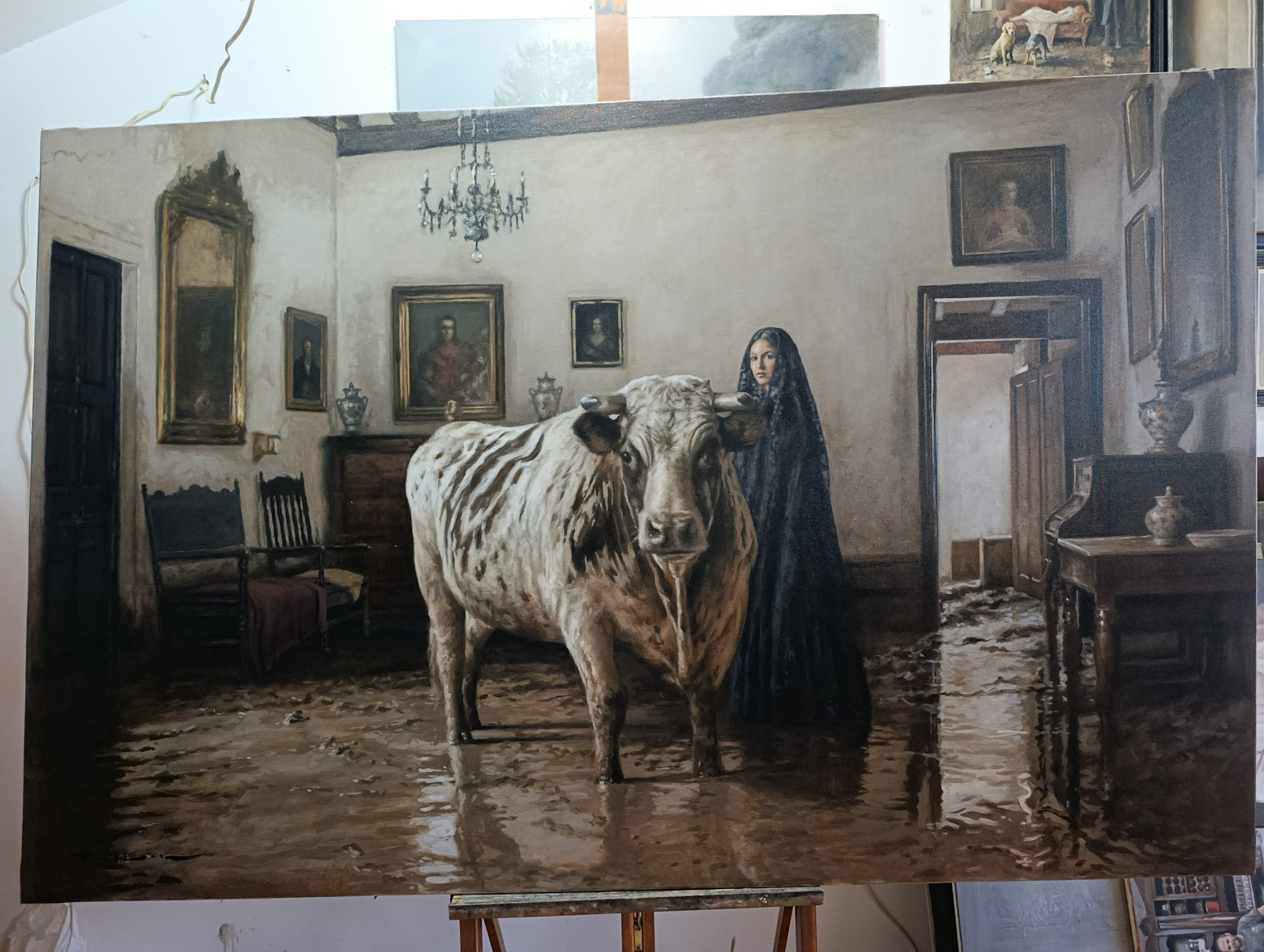
Working primarily in oil, Correa employs controlled brushwork and careful modelling of form to create figures that feel structurally convincing yet quietly unsettled. His chiaroscuro is dramatic without becoming theatrical, using light to shape mood rather than simply describe form. This allows the impossible to exist convincingly within otherwise believable spaces. His narratives remain deliberately unresolved, inviting viewers to bring their own experiences to the work and linger in the space between reality and imagination.
The artist maintains a studio practice in Santiago. He has also undertaken public projects, including the documented mural Mercado de Santisteban, demonstrating the broader application of his figurative approach.

In conversation with The Exclusivist, Correa explores the influences behind his work, from classical training and cinema to literature and philosophy, as well as the role of light and memory in shaping his visual world.
Q&A With Boris Correa
This interview was translated from Spanish into English, with care taken to preserve Boris Correa’s original tone, expression and intent.
Foundations
Long before formal academy training, what first brought you to drawing and painting? Was there a specific environment, an early impulse, or a particular encounter with art that started it all?
From a very young age, I drew constantly. I was never particularly interested in going outside to play; I preferred staying at home drawing. When I was a teenager, my father opened a video rental shop, and that was when I discovered cinema. It was there that I encountered the work of several directors who profoundly shaped the way I understand images.
For a time, I wanted to devote myself to filmmaking, and I even made a couple of short films. However, I soon realised that working with large crews did not suit the way I create. My path was more intimate and solitary, so I decided to study painting. I fell in love with it from the very beginning.
Over the years, I came to understand that I had never really left cinema behind. My paintings are deeply connected to it. Unconsciously, I am always trying to construct scenes with a strong cinematic quality, as though each painting were a single frame frozen from a story that the viewer must complete.

Atelier Lessons and the London Transition
Your training began in the traditional atelier system under Martín Soria before continuing your practice in London. Looking back, what were the core lessons from those foundational years under Soria, and how did changing environments influence your work? At what point did you begin to move beyond strict technical discipline towards defining your own artistic voice?
My time in a classical painting atelier gave me something I consider indispensable: technical knowledge and discipline. It was there that I understood painting does not depend solely on inspiration, but on observation, patience and hard work. We spent hours drawing and painting from life, learning to understand light, form and anatomy before attempting to express an idea. That technical foundation was essential.
When I moved to London, I had the opportunity to see in person the painters I had always admired. I spent countless days wandering through the National Gallery. I also came into contact with a very diverse artistic scene, where ideas carried as much weight as execution. I stopped seeing technique as an end in itself and began to understand it as a language in the service of a personal vision.
There was never a single moment when I felt I had found my own voice. It was a gradual process. Little by little, I realised that the images that genuinely interested me were born from literature and cinema, from the need to create scenes charged with tension and mystery. That was when painting ceased to be an exercise in representation and became a way of constructing stories.
I still believe technique is essential, but it only has meaning when it disappears and leaves room for emotional impact. I try to create images that remain in the viewer’s memory.
From Impulse to Finished Work
Your work often carries literary and philosophical undertones. When you begin a painting, are you typically responding to a visual idea, a philosophical question, or something you’ve encountered in literature—and how does that initial spark evolve into a completed piece?
I almost always begin with an image. It may appear unexpectedly while I’m walking, watching a film, reading a book or even in a dream. It isn’t a fully formed idea, but rather a fragment: a room, an animal, a gesture or a particular quality of light. Once that image settles in my mind, I feel the need to develop it.
Literature and philosophy are very important to me, but they rarely serve as a direct point of departure. Instead, they create the atmosphere in which I think. Writers such as Kafka, Borges and Camus and filmmakers like Tarkovsky and Bergman have shaped the way I understand mystery, silence, memory and the human condition.
My process is deeply intuitive. I usually begin with a visual impulse and allow the painting itself to reveal its meaning as I work. Very often, I don’t fully understand what a painting is about until it is finished. Only then do I discover that, in one way or another, it returns to the same recurring concerns: my relationship with nature, my insomnia, solitude, or the search for meaning.
For me, a painting should open up a space for uncertainty. I’m interested in allowing the viewer to project their own memories, emotions and interpretations onto it.

Realism and the Inner World
Your figures feel real yet inhabit spaces that seem shaped by internal experience. How do you decide how far to let psychological or symbolic pressure distort the realism of the scene?
I’m interested in making the viewer look at the scene as though it could genuinely exist, even while sensing that something impossible or unsettling is taking place.
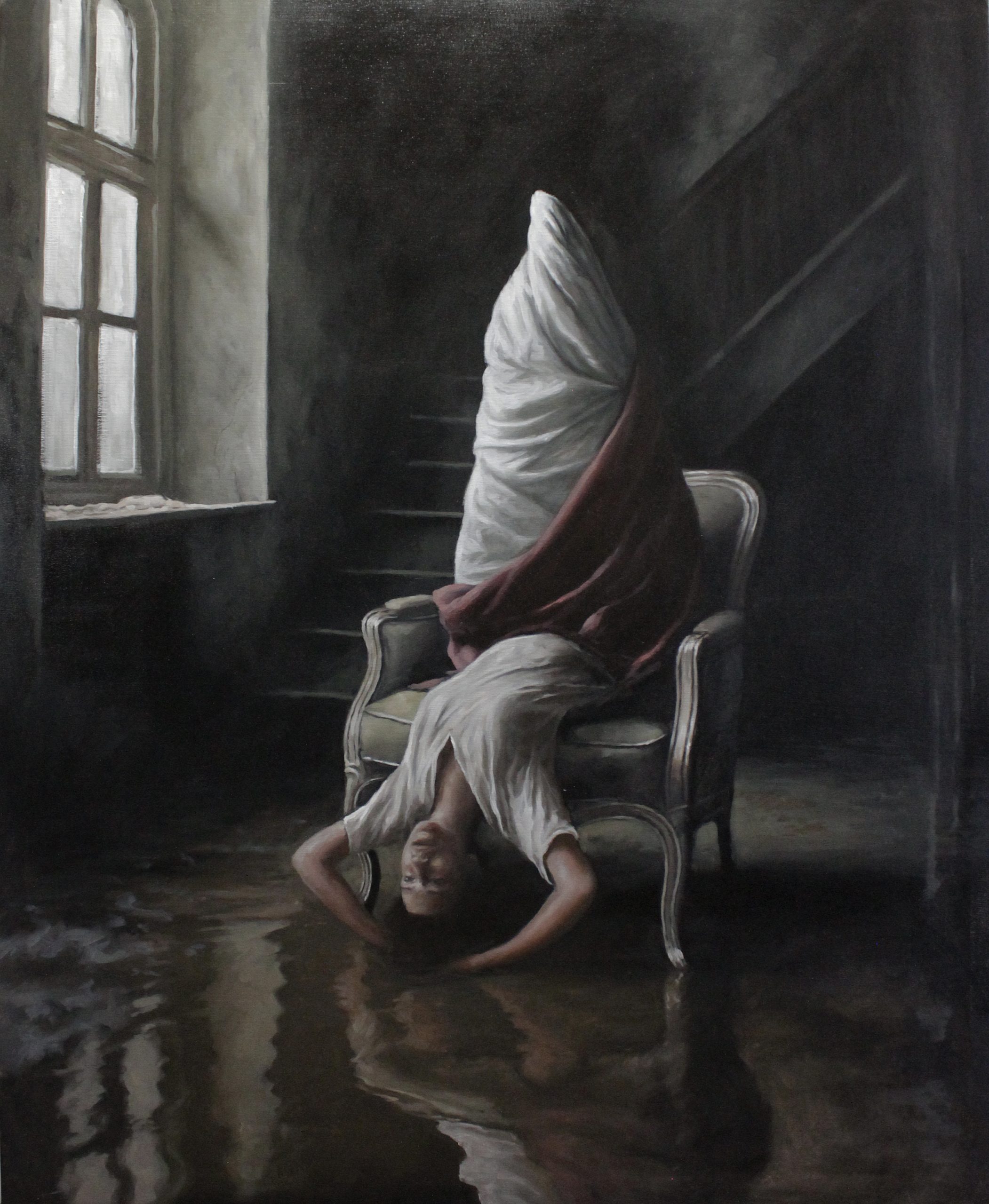
I believe symbolism loses its power when it is presented too explicitly. I prefer it to emerge quietly, integrated into the internal logic of the image. A horse inside a room, a floor covered in mud, or a figure suspended in space are elements that disrupt reality and generate a tension that is difficult to explain in words, inviting the viewer to complete the meaning through their own experience.
For me, realism is not simply about faithfully representing the visible world. If a scene succeeds in conveying a feeling of silence, strangeness or melancholy, then it is already real, even if what it depicts is impossible. In that sense, I feel very close to the language of dreams and cinema. In dreams, we accept completely improbable situations without questioning them, and something similar happens in film: an image can carry enormous psychological weight without needing to explain itself. I aspire to make my paintings function in the same way—as places where reality and the inner world coexist without conflict.

Cinematic Light and Atmosphere
Your paintings carry a cinematic intensity reminiscent of directors like Tarkovsky or Bergman. Without movement or time on your side, how do you structure a static image so it feels like a frame pulled from a larger narrative—suggesting both what has just occurred and what is about to happen next?
Obviously, it is impossible to translate a film directly into painting. What interests me is the sense of suspension found in certain film stills: the impression that the story exists both before and after the moment we are looking at.
When I begin a painting, I think a great deal about what lies outside the frame. I ask myself what has just happened in that room, why that figure is there, or what will happen once the viewer looks away. Although those answers are never shown explicitly, they shape every compositional decision I make.
Light plays a fundamental role. I don’t use it simply to model form, but to create an emotional state. Dramatic side lighting, a space half lost in shadow, or a kind of visual silence can generate far greater narrative tension than any obvious action. I’m interested in making the viewer feel that something is about to happen, even though that event never actually arrives.
I also try to eliminate anything that feels anecdotal or incidental. The more distilled the scene becomes, the more space is left for the imagination. In that respect, I deeply admire Béla Tarr. In his films, silence, rhythm and composition carry as much weight as the events themselves. I try to make my paintings work in a similar way—not by telling a story literally, but by inviting the viewer to imagine it.

The Dreamlike Series and Future Trajectory
You’ve recently been sharing works from your Dreamlike series, a body of paintings that explores a more surreal, suspended atmosphere. What was the catalyst for this specific body of work, and as it develops, are there larger scales or new technical directions you plan to take with it?
For some time now, I’ve been interested in creating images that exist in an ambiguous space between reality and dreams, between the everyday and the inexplicable. With this series, I’ve simply taken that idea a step further.
The starting point was a need to strip away any overly obvious narrative elements and place greater trust in the dreamlike power of atmosphere. I wanted the scenes to feel like incomplete memories or dreams we never quite understand, where every object and every figure seems to carry meaning.
In this series, the spaces are just as important as the figures. Rooms, animals, mud and everyday objects cease to be merely compositional elements and become protagonists in their own right. I’m interested in making it impossible for the viewer to determine with certainty whether they are looking at a real place or a construction of memory.
Looking ahead, I’d like to take these ideas to increasingly larger formats. Scale completely transforms the experience of a painting: it allows the viewer not only to observe the scene but to feel as though they could step into it. I also want to continue exploring the relationship between technical precision and narrative ambiguity. The more convincing the reality I construct, the more powerful the sense of strangeness becomes when the impossible appears.
Ultimately, my aim remains the same as it was at the beginning: to create images that stay with the viewer long after they have seen them.

A Personal Language of Realism
Boris Correa’s work demonstrates the continued relevance of realism as a form of artistic inquiry. He pairs the technical rigour of classical training with a contemporary interest in memory and psychology, treating accuracy as a starting point rather than an end. His paintings reflect a considered approach to figurative practice, combining technical discipline with a clear sense of personal intent.
Photo credits (right-hand side, top to bottom): Mulher Adormecida, La Dama del Armiño, La Nausea, El Poeta, The First Morning, Autorretrato Nocturno, After the fire, all © Boris Correa
Boris Correa Instagram