
In the spring of 1884, John Singer Sargent unveiled a portrait at the Paris Salon that he expected would define his career. It did—though not as he had planned. His subject was Virginie Gautreau, a Louisiana-born socialite and one of the most photographed women in Paris. Sargent had spent over a year persuading her to sit for him—writing letters, visiting her country estate in Brittany, and gradually wearing down her resistance until she agreed.
What he produced—a stark, pale figure in a plunging black gown, rendered in sharp profile with an air of cool defiance—provoked such outrage at the vernissage that Gautreau’s mother publicly confronted him and demanded its removal. He refused, but the damage was done. Within months, Sargent left for London, his reputation bruised, taking with him the canvas he would keep in his studio for thirty years. He eventually sold it to the Metropolitan Museum of Art on the condition that Gautreau’s name never appear on the label. The painting, known as Madame X (Madame Pierre Gautreau), remains on view at the Metropolitan Museum of Art in New York.

A Nomad’s Education
Sargent never had a settled home. He was born in Florence in 1856 to American parents—his father a physician, his mother an amateur watercolourist—and grew up moving between rented apartments in Italy, France, Germany, and Switzerland. Formal schooling was irregular, but drawing came early and never left him. By twelve, he spoke four languages and had already filled sketchbooks with the architecture and landscapes of half a dozen countries.
At eighteen, he enrolled in the Paris studio of Carolus-Duran, a fashionable portraitist whose teaching was rigorous and direct: look at your subject, judge the tone, place the stroke, and move on. There was no reworking, no cautious layering—just committed paint from the first mark. Sargent thrived and spent his early twenties building on this through travel. In 1879 he went to Spain to study Velázquez at first hand. The following year he visited Haarlem to examine Frans Hals, whose fast, apparently unguarded brushwork showed that speed and precision were not opposites. Both encounters shaped everything that followed.
In 1881, still only twenty-four, he painted Dr. Pozzi at Home, a full-length portrait of the charismatic French surgeon Samuel Pozzi in a deep crimson dressing gown. One hand is raised to his collar; his bearing sits somewhere between assurance and theatre. Pozzi was one of the most celebrated men in Paris: a pioneering gynaecologist, a socialite, and a figure who moved easily between operating theatre and salon. The painting, now in the Hammer Museum in Los Angeles, remains one of the most arresting male portraits of the century.

Two years later, in 1882, he completed El Jaleo, now in the Isabella Stewart Gardner Museum in Boston. Nearly twelve feet tall, it places a flamenco dancer at the centre of a composition that dissolves at the edges into shadow and motion. The brushwork is broad and suggestive, yet the heat, noise, and physical energy of the performance register immediately.

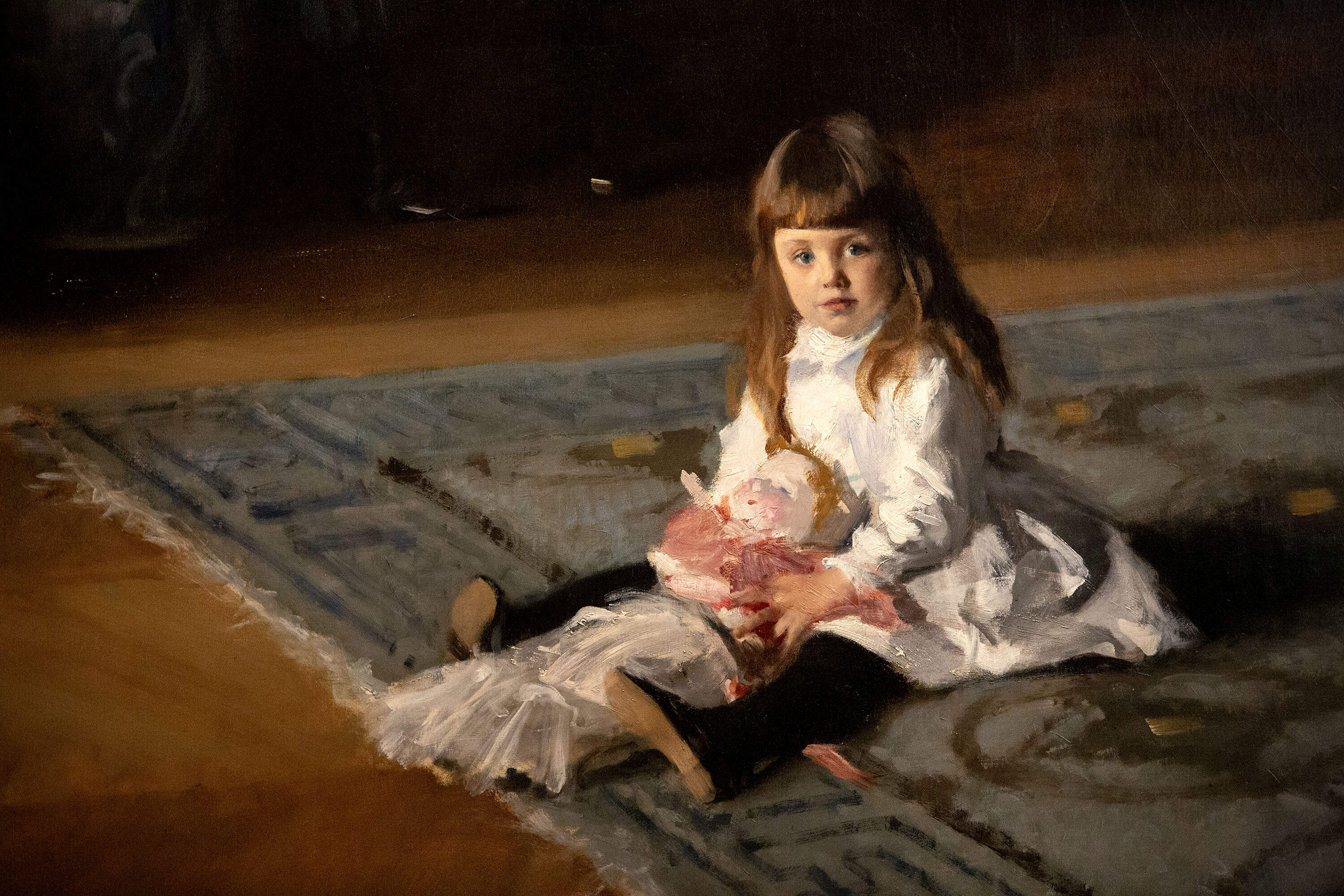
That same year, he painted The Daughters of Edward Darley Boit, commissioned by a wealthy Boston expatriate and amateur painter he had met on the Paris social circuit. The four Boit sisters are arranged across a large, dimly lit apartment hallway, with the two youngest in the foreground and the older pair receding into shadow at the back, their faces barely resolved.
It is a formal portrait that refuses to behave like one. There is no focal point, no conventional hierarchy of figures, and no clear suggestion of occasion. Visitors to the Salon found it unsettling. Sargent offered no explanation. It now hangs at the Museum of Fine Arts in Boston and has lost none of its strangeness.

Reinvention in London
London was not an obvious choice. Sargent had no particular connection to the city, and his reputation there was untested. Paris had become untenable—the Gautreau scandal had made him a liability to the very social world his portrait practice depended on, and clients who might otherwise have sought him out hesitated. London, by contrast, was a city with appetite, money, and no memory of the scandal. He established a studio on Tite Street in Chelsea—the same street where Whistler worked, with Oscar Wilde a few doors along—and set about rebuilding. He found his footing quickly, joining a loose circle of writers, painters, and musicians who gathered each summer in the Cotswolds village of Broadway.
It was there, in a cottage garden in 1885, that he began Carnation, Lily, Lily, Rose. He painted two small girls—daughters of Frederick Barnard, a fellow artist and close friend from the Broadway circle—lighting Japanese paper lanterns among tall garden flowers at dusk. The technical challenge was unforgiving: Sargent would paint only during the brief window each evening when the fading light matched exactly what he was after, before the conditions shifted. He returned to it over the next two summers. When it appeared at the Royal Academy in 1887, it was purchased immediately for the national collection and now hangs in Tate Britain.

The Weight of Demand
Commissions came steadily, and then relentlessly. The aristocracy, the newly wealthy, and the Gilded Age Americans who crossed the Atlantic each season with a portrait in mind all found their way to Tite Street. Sargent painted them with the same unflinching eye: broad wet-into-wet brushwork, thin glazes for skin, and quick highlights for silk or jewellery. He captured character not through expression but in how a sitter held themselves—a tilted chin, the angle of a wrist, the way someone occupied or failed to occupy their chair.
Lady Agnew of Lochnaw, shown at the Royal Academy in 1892, cemented his reputation in Britain. Gertrude Agnew, the wife of a Scottish baronet, had met Sargent at dinner, and he asked to paint her. She sat in a sheer white muslin dress, settled gracefully into a bergère chair, her gaze steady, self-possessed, and quietly commanding. The jade-green brocade behind her anchors the composition, while the figure dominates it effortlessly. The Scottish National Gallery acquired the painting in 1925, and it has remained there ever since.

In 1899, Sargent painted The Wyndham Sisters—Percy, Pamela, and Madeline, the daughters of the Hon. Percy Scawen Wyndham—seated together on a sofa in flowing white gowns against a warm, dark background. The composition is at once relaxed and formally controlled, the figures positioned with an effortless authority that belies the careful calculation behind it. Among the most celebrated women in Edwardian London, the sisters are rendered with a collective ease that reflects both their social confidence and Sargent’s technical mastery. The painting now hangs at the Metropolitan Museum of Art in New York.

Around the same period he painted Lady with the Rose — Charlotte Louise Burckhardt, the daughter of a New York family he had known since his Paris years, not as a commission but because he wanted to. She holds a single white rose at her side, her expression thoughtful and her bearing entirely unstudied. The picture is quieter and more personal than anything produced for paying clients. It is now at the Metropolitan Museum of Art in New York.

By the mid-1890s the pace of formal commissions had become a constraint he increasingly resented. He said so plainly in private correspondence, describing portrait work as something he endured rather than chose, though the income continued to underwrite the work he actually valued. He reduced his commitments steadily from the early 1900s, accepting only occasional portraits thereafter and refusing to be drawn back into the full cycle of sittings and social obligations that the trade required.
Beyond the Drawing Room
Freed from the commission schedule, Sargent turned to the work he had always wanted to do. Watercolour had always been part of his practice but now became central to it. Each summer he took himself to Venice, the Alps, Corfu, Spain, or Morocco, painting quickly and completing sheets in single sessions with the same brevity of stroke he brought to oils. His Venetian studies are particularly significant: gondolas on narrow canals, the play of light across water and stone, the compressed geometry of the city seen from roof terraces and bridges. They are not topographical records but investigations of light and atmosphere, and few painters before or since have handled the medium with the same assurance. These works are among the most actively traded on the secondary market today.


In his later years he also returned to the figure in a more personal register. Nonchaloir (Repose), painted in 1911, shows his niece Rose-Marie Ormond lying across a sofa, half-absorbed in fabric and cushions, reading. It is the antithesis of the formal portraits — private, unhurried, and painted with a luminous looseness that reflects how far his handling had evolved from the disciplined brushwork of the Paris years. It now hangs at the National Gallery of Art in Washington, D.C.

Sargent also undertook mural commissions for the Boston Public Library and the Museum of Fine Arts, work that occupied him intermittently for nearly thirty years. The subjects—drawn from comparative religion and classical mythology—were worlds apart from his society portraits, a contrast he embraced deliberately.
In 1918, already in his early sixties, he accepted a commission from the British War Memorials Committee to travel to the Western Front as an official artist. Near Arras, he came upon a scene that stopped him in his tracks: a column of soldiers, blinded by mustard gas, being guided across a battlefield at dusk, carefully stepping around those already lying on the ground.
Sargent sketched what he saw and returned to London to paint Gassed, completed in 1919. The canvas, measuring nearly seven metres wide, depicts no explicit violence, uses no rhetorical device, and makes no attempt to direct the viewer’s response. Instead, it presents a long, meticulously rendered procession of men, their eyes bandaged, moving with the measured, cautious gait of those who cannot see where they place their feet. Sargent approached the scene with the same precise, dispassionate observation he had applied to Edwardian drawing rooms—his familiar method, applied to an entirely different world. The painting now hangs permanently at the Imperial War Museum in London.

Sargent never married. He kept a small circle of family and long-standing friends and was known to be intensely private about his personal life. After 1907 he declined almost all formal portrait commissions, preferring the freedom of landscape and independent figure work. He died of heart failure in London in April 1925, the morning after a dinner party with friends. He was sixty-nine.
The Market for Sargent
The past several years have seen notably stronger prices across all categories of Sargent’s output. Major society portraits with documented provenance and exhibition history regularly achieve seven- and eight-figure sums at Christie’s and Sotheby’s in London, which handle the most significant lots. Venetian watercolours and early travel oils have remained consistently active at auction, while preparatory studies for well-known works attract serious attention from buyers seeking proximity to the finished paintings at a lower level of financial commitment.
Watercolours have moved firmly beyond their former secondary status and now sit alongside oils as a primary collector category. Renewed public interest—driven by major retrospective exhibitions and a broader cultural engagement with the Gilded Age and Edwardian periods—has brought new buyers into competition with established collectors. The society portraits of the 1890s continue to attract the highest prices, but Venetian watercolours and late figure studies have been gaining ground steadily.
The market is selective, and that selectivity matters. Works with limited ownership history or unresolved attribution can stall regardless of visual quality. With an artist who worked at considerable pace and whose approach attracted both admiration and imitation, expert authentication and a fully documented provenance chain are essential; buyers should insist on both before proceeding. London remains the natural venue for British and European sellers, combining specialist knowledge with access to the broadest international pool of buyers.
Why It Holds
Sargent was at the height of his powers during the final decades of an era that the First World War brought to a close. He had unrivalled access to it — its houses, its people, its social fabric — and the technical means to record it with precision. The confidence and privilege he documented never quite reassembled itself after 1918. What he produced in those four decades is the only record of its kind.
Photo credits (right-hand side, top to bottom): Portrait of Lady Helen Vincent (1904), Almina, Daughter of Asher Wertheimer, Mrs. Carl Meyer and Her Children (1896), and Ellen Terry as Lady Macbeth, all by John Singer Sargent.


